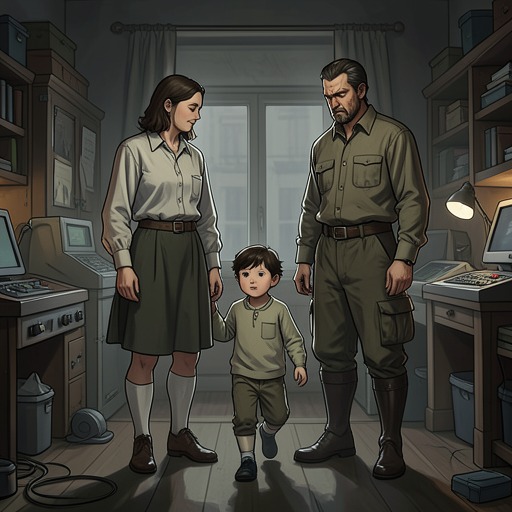
Todd Hewitt and Cillian Boyd: stern care and affection
The Knife of Never Letting GoTodd Hewitt and Cillian Boyd’s relationship is defined by a stubborn mismatch between the care Cillian provides and the care Todd can recognize. Their daily life is full of work, corrections, and irritation, and their Noise makes that friction public. Yet when Todd has to leave the farm under threat, Cillian embraces him and stays behind to hold off the pursuit. The parting exposes an affection that their familiar antagonism had kept difficult to see.
Daily Life and Uneven Care
Cillian’s care for Todd is embedded in a demanding household routine rather than expressed through easy warmth. Todd recalls that Cillian arranged for a puppy to be given to him for his birthday, although Todd had wanted the fissionbike repaired instead. The gift becomes another responsibility: Todd feeds, trains, washes, and walks Manchee, whose talking adds to Todd’s frustration. Cillian’s gesture may have been intended as a present, but Todd experiences its consequences as work he never asked for. Their relationship is thus established through a small domestic mismatch: an adult’s choice offered as a birthday gift becomes a burden in the child’s account of it.
That burden sits within the farm’s larger strain. Cillian is often occupied repairing the fission generator, and Todd returns from gathering swamp apples for Ben to find him working on it. Cillian immediately asks where Todd has been and says there is work to do. Todd hears accusation rather than concern; Cillian, focused on the generator and the work still awaiting them, treats the interruption as another sign that the chores are not getting done. Neither interpretation cancels the other: the farm needs labor, while Todd experiences the demands as relentless.
Cillian’s explanation of their situation gives the conflict a material cause. He insists that the adults cannot keep the farm running alone, and Todd privately recognizes the truth of that claim even as he resents the work assigned to him. The town, Todd understands, can only shrink, and help is not coming. Their arguments are therefore not simply a clash of temperaments. They take place inside a failing economy of labor, where Cillian’s practical urgency and Todd’s sense of being overworked meet without resolving into agreement.
Noise and Repeated Conflict
The two are especially poor at concealing irritation from one another. Todd describes their Noise as throbbing with anger and aggravation, and says that this has long been the pattern between them. He contrasts Cillian with Ben, whom he regards as the kind one, while Cillian is the difficult one. As Todd’s thirteenth birthday approaches, he imagines becoming a man as a way to escape having to listen to Cillian’s instructions. The expected change in status intensifies the conflict: Todd sees adulthood as release from a relationship that currently feels governed by orders.
Their exchanges show how easily routine correction becomes personal antagonism. Cillian tells Todd to pay attention; Todd objects to being watched so closely. When Todd tries to make clear that something happened on his trip, he feels that Cillian does not ask about it and redirects him to the sheep. Todd answers with a sarcastic imitation of the conversation he wishes Cillian would have had, turning the unmet question into an open challenge. Cillian tells him to watch his mouth and return to his work. Todd clenches his fists and leaves with Manchee. The scene does not settle who is right about the chores; it shows how a practical disagreement narrows the space for Todd to be heard.
Noise sharpens this pattern because inward irritation is audible to the other person. Todd’s resentment is not confined to what he says, and Cillian’s own frustration is likewise present in their exchanges. Their conflict is therefore both spoken and exposed: even when one of them might prefer to move past an argument, the feelings accompanying it remain part of what the other encounters. This makes their repeated clashes harder to separate from their underlying attachment, but it does not make that attachment easy for Todd to trust.
The Farm Becomes a Place of Danger
The relationship changes when Mr Prentiss Jr comes to the farm. After a confrontation, Cillian has Mr Prentiss Jr’s rifle and directs him off the property. The incident makes Cillian’s position clear: he is prepared to defend the household against an immediate threat. When Mr Prentiss Jr leaves, Cillian says that Todd has to go at once, back through the swamp. The farm that had organized their arguments over work is no longer a safe place for Todd to remain.
Cillian’s decision to send Todd away is not presented as a punishment or a rejection. Ben and Cillian both understand the necessity, and Cillian says that he had hoped events would not come to this. He tells Todd that he may hate them for what they are doing, but asks him to believe that it is because they love him. Todd refuses the explanation in the moment, insisting that the situation is not all right. His resistance matters: the reassurance does not erase the fear and anger of being sent away, especially when he has little time to absorb what is happening.
Cillian then turns from explanation to action. He tells Ben to take Todd while he remains behind to delay the men pursuing them. The choice reverses the emphasis of their ordinary relationship. The man Todd has associated with commands and irritation now accepts danger in order to give Todd a chance to escape. Cillian’s decision is not proof that their disagreements were imaginary; it reveals what those disagreements had failed to show about the depth of his commitment.
The Last Parting
Before Todd leaves, Cillian pulls him into a hard embrace. Todd is startled and pushes him away, responding to the physical closeness with the same immediate resistance that has marked their arguments. Cillian’s declaration of love reaches him, but does not instantly persuade him. The sequence holds both responses together: Cillian offers tenderness without ceremony, and Todd, still overwhelmed, cannot receive it as uncomplicated comfort.
Cillian’s plan to stay behind makes the embrace more than a sudden exception to his stern manner. He picks up the rifle again and prepares to hold off the pursuit while Ben leads Todd out through the back. As Todd is taken away, Cillian catches his eye. Todd understands the look as a larger goodbye than either of them had made explicit, and as evidence that Cillian does not expect to see him again. The door closes before Todd can answer. Their parting ends not with a reconciliation in words, but with Cillian remaining at the farm and Todd being carried into escape.
Significance and Limits
Cillian’s importance to Todd is clearest in the gap between Todd’s everyday judgment and the final evidence of his actions. Todd has reason to experience him as demanding: Cillian corrects him, insists on chores, and fails to respond as Todd hopes when he tries to raise what happened on his journey. At the same time, Cillian shares the work of sustaining the farm, gives Todd a birthday present, expresses love, and puts himself between Todd and the pursuit. The relationship cannot be reduced either to the boy’s sense of being burdened or to the adult’s last act of protection.
The parting also arrives before the two can work through their habitual antagonism. Todd’s resistance to Cillian’s reassurance remains visible, and the farewell is cut off by the closing door rather than completed through a conversation. The relationship is therefore left in a painful but newly legible state: Cillian’s care has become unmistakable to Todd precisely when their separation makes it impossible to answer. The affection was present beneath the friction, but its clearest expression comes as Cillian stays behind and Todd is forced to go on without him.